

I picked up You’ll Miss Me When I’m Gone by Rachel Lynn Solomon partially as research, but mostly because it was written by Rachel Lynn Solomon. I’m in the middle of working on a manuscript that involves a character discovering her daughter has a genetic disorder. When I saw Solomon, who I’ve done another blog post for before, had a book about twin sisters going through something similar, I couldn’t pass up the opportunity to see how another writer had tackled this issue.
Here goes: Tovah and Adina are twin sisters with only one thing in common, they have their futures after high school meticulously planned out. Tovah is set on becoming a surgeon, while Adina is a gifted viola player. But when one of them tests positive for Huntington’s disease, she struggles to envision her future living with the affliction she’s watched slowly consume her mother. The other grapples with the guilt brought on by her negative diagnosis. Each sister must decide how to deal with the hand she’s been dealt, and if they can be there for one another in the meantime.
I’ve always had a fascination with genetics. So much so that in high school I took an extra elective in that area. Back then, I briefly toyed with the idea of becoming a genetic counselor. That never happened, but one thing that I like about writing is being able to create characters and situations that allow me to research things I’m curious about and put them to use. I remember learning about Huntington’s disease as a junior. Later, when I was teaching, I would read a book about Nancy Wexler with my students. She’s a doctor who has devoted years of her life searching for a Huntington’s cure by regularly traveling to a village in Venezuela with a high concentration of people suffering from the disease.
As I read about Huntington’s it was impossible not to think about Solomon researching for her writing. I got caught wondering how she decided which facts to use in her story and which to leave out. I like knowing where she took a fact and twisted it to make it personal for a character. Since Adina and Tovah had both watched their mother suffer from Huntington’s, the symptoms were displayed firsthand: muscle spasms, cognitive decline, hallucinations, and behavioral changes. Depending on the onset, neither of the girls’ chosen careers will be possible once these symptoms present themselves. Unfortunately, people with Huntington’s tend to develop symptoms in their thirties or forties, and at that point are looking at ten to thirty years life expectancy. During that time, they will rely heavily on a caregiver. The wide range of possibilities and the uncertainty attached to them are explored realistically by the girls as they attempt to finish high school and tackle their future given the overwhelming nature of what they are experiencing. I can only hope that I do the same justice to the representation of the genetic disorder I picked for my current work in progress.
There you have it so yourself a favor and read You’ll Miss Me When I’m Gone. Do some extra reading on Huntington’s or maybe another genetic disorder. Look into Nancy Wexler and her extensive research in this area. See how it affects your perspective of this story.
If you haven’t already read You’ll Miss Me When I’m Gone, what are you waiting for? If you already have, why not pick it up again? Either way, take my advice when you do—don’t just read it, experience it.
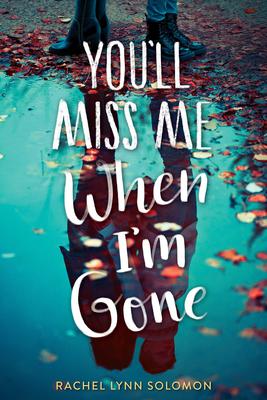
Want information about purchasing this book from Neighborhood Reads, a local Washington, MO book store? Click the book cover above!
 Anna LaForest Writes
Leave a comment